

This essay outlines the chronological and geographical scope of the first part of the two-part Social Science Files project on the universal history and theory of society.
On the dimension of time
In coming essays I explore 6 concepts which, with their corresponding real and imagined historical-empirical examples, facilitate an understanding of the trajectory of human evolution during all prehistory up until the inventions of writing, numeracy and record-keeping. The principal variable is identified as the decision making process.
These six concepts are:
‘personalistic neoprimate domination’ (state of nature)
‘repersonalised networked levelling’ (efforts to manipulate nature)
‘depersonalised individualistic society’ (efforts to reform nature)
‘impersonal communalistic society’ (a new equilibrium of nature)
‘depersonalised coordinated society’ (a limited struggle to reequilibrate)
‘depersonalised administered society’ (an expansive struggle to reequilibrate)
To set the scene: a nearest-to-present historical setting is desirable. This month an archeological claim1 to find evidence of deliberate fire-making 400k years ago was immediately disputed. Previously, fire making had been dated only to 50k years ago. The latest claim might be “stretching the evidence”. Hominins could have been using fire for cooking, tool making and day-extensions for well over a million years. But there are great differences between fire use, fire management, and fire making. There is evidence that Neanderthals built hearths and transported balls of heated bitumen between camps.2 It is possible that the sources of heat obtained in natural rather than manmade fires could be kept alive, transported, and rekindled during movements of camps. Therefore, it is possible that 400k years ago hominins could routinely cook their meat and pulses. The dating of the use of flint and pyrite struck together to make fire from scratch, however, remains a matter for debate. At stake is a massive 350k year difference in a single core variable for the measurement of human progress, with knock on effects in other areas. For example, this new twist in the archeological debate has knock-on ramifications for debates in psychology and biology about the dating of encephalisation (enlargement of brains) and cognitive capacity (e.g. for managing complex time budgets, facilitated by dietary changes, enabled by fire). It may also bear on calculations of group sizes, and preconditions for group-level decision making which, in turn, may be determined by capabilities for fire making. If we play safe and accept the year 50k marker for fire making, then we have a basis upon which to hypothesise that the formation of societies could be dated to 50k years ago. People needed to hold public discussions after work, in the evenings. In order for them to maintain political life alongside subsistence they required the campfire.
Why do I mention this? Because an analogy between the making of societies and the making of fires obviously presents itself. It is one thing to ‘use’ sociational techniques or to ‘manage’ sociations (e.g. through coupling and discussion), but quite another to ‘make’ societies from scratch without prior discovery of how to strike up the sparks of a competitive decision making process. Since there is no extant evidence, and since enormous epistemological risks are run by relying on contemporary proxy-primitive evidence of how hunter gatherers and chieftainships made their decisions — say in 1875 or in 2025 — there are clear advantages to bringing both the timelines and the geographical settings as near as possible to the evidence available from recorded history.
Here we come to the crunch. Though I have not yet provided detailed definitions and examples of the six concepts identified in the first paragraph, readers may tolerate a preliminary digression into problems of dating the relevant changes. There is no point in insisting on a point of departure 150k or 50k years ago if it invites uncertainty.
If whatever was happening then was still repeating itself with more demonstrable certainty 20k or 10k years ago, then accuracy trumps authenticity. A set of evolutions from ‘neoprimate dominance’ into ‘networked levelling’ and then into ‘communalistic sociation’ could, in theory, have begun with acquisitions of language 120k years ago. Nevertheless, given the demonstrably extremely slow evolution of language and the associated cognitive potentials for collaboration and coordination, it seems unlikely that anatomically modern humans were already experimenting with transitions to impersonal society as long ago as 120,000 BCE. The latter does remain a theoretical possibility. Archeologists do occasionally discover evidence of technical achievements suggesting human organisation that seem completely out of sync with the prevailing patterns elsewhere.3 This always depends on some form of physical evidence, which is not available for political-organisational forms. The possibility deserves analysis. In favourable geographic conditions there only needed to be one exceptional effort at sociation (society formation) for news of it to spread and for emulations to begin.
On the other hand, if this process really was a logical and natural course of evolution then its benefits had to have been apparent in and of themselves in order that they might potentially be intelligently reproduced anywhere and at any time simply on the grounds of a universally perceivable common sense deduction about the benefit it then held for a group’s priority means to ends, i.e., without that group having any knowledge of prior experiments and preconditions (that we as distant observers or interpreters may consider to have been valid in theoretical terms). A change of such magnitude and consequence for humans had to have been simultaneously rational and sensibly-motivated in all circumstances. It is therefore conceivable that 120k years ago evolved humans abandoned groups where neoprimate Dominators personally made all of the overriding decisions. As a progressive alternative, they then might have skipped the Leveller option and begun to make highly individuated decisions in an ethically communalistic political framework using deliberately impersonal procedures that over time would become structured as routine political mechanisms. This process would have been a radical departure on the road to an open political society.
However, if we are fairly certain that humans probably could not and did not ever or anywhere progress beyond ‘communalism’ into ‘coordination’ until at least 20k years BP then we have no choice but to assume that back-and-forth transitions between neoprimate dominance, networked levelling and sociation were recursive for 100k years. It seems indisputable that sociational living was politically far more demanding of human experimental time, patience and tolerance than either simple Dominance or Levelling. Groups would have reversed or fissioned continually as they trialled and erred between these three options. What we can say with confidence is that the transition to ‘coordination’, which broke the chains of the recursive circle, could not have occurred until options for society had already escalated in terms of innovation and size into a full well-established communalism. That was a long learning process. The transition to coordination required an increase in knowledge of production and consumption alternatives in a context of favourable material and climatic conditions. Therefore, I have shifted the timescale to 20,000-10,000 BCE while remaining aware of the preceding changes dating as far back as 120,000 BCE when language took hold.
On the dimension of place
Before discussing the challenging and revolutionary force of ‘depersonalisation’ by which societies were formed, we need to establish a credible and useful geographical incubator, one which could have remained empirically valid (even when implausible) over the prior 100,000 years, and (with greater plausibility) into the 50,000-40,000 BCE time frame that marks the beginning of the Upper Palaeolithic. I want to ensure that small groups were still undertaking the full range of sociopolitical transitions within condensed time periods on the eve of the first ‘depersonalised administered societies’ circa 4000-2000 BCE in Mesopotamia. It should be feasible to imagine impersonally-governed mobile cave-dwelling hunter gatherer societies evolving into coordinated settler societies in a matter of single generations, before they become administered. This leaves the ancient Near East as the only viable location. I will, therefore, focus on a movement from the Zagros Mountains into the plains of Levant and Mesopotamia.
Practical reasons for situating fully-fledged formations of society within the ancient Near East 20,000 to 10,000 years ago are as follows. In the beginning of human artistic and technological development characteristic of the Upper Palaeolithic the most plentiful evidence is found in Europe, for example Aurignacian lithics, artefacts and wall paintings.4 However, the bulk of the archeological evidence suggestive of early socioeconomic and political development during the critical phases of settlement and cultivation (that will concern us later on) is concentrated in the Levantine Natufian, from where it spreads into Mesopotamia. Although, the initial individualistic and communalistic sociational innovations could have occurred anywhere I imagine the ‘first’ and ‘second’ societies emerging in mountains north of Mesopotamia, and ‘third’ societies in the Levant. The ‘fourth’ societies began within easy walking distance in Mesopotamia. An evolutionary process is best viewed diachronically in a single region.
Moving the period of study from 100,000 years ago or 40,000 year ago to, say, 15,000 years ago can only improve the quality of the analysis. The primary reason for doing so is that whatever fundamentally occurred in terms of sociation and organisational patterns 100,000 years ago was still reoccurring in much the same way 10,000 years ago.
Granted, there were environmental geological and climatic changes over the period. There were changes in human and animal migrations, and changes in the quantum of exchangeable human knowledge. However, human brain size and anatomy remained stable. From our most distant perspective on the emergence of the first two societies nothing of great significance changed for 100,000 years. The human political world was comprised of mildly-developmental neoprimate Dominators, non-developmental reactionary Levellers, and two subtypes of developmental entrepreneurial sociation, which, though they grew in size and technique over time, were uniquely characterised by their combination of Individualistic-Communalistic participative decision making.
[These various categories will be topics of forthcoming Social Science Files essays.]
It is unlikely that changes in climate or other environmental factors determining the modes of subsistence and economic decisions were also the primary determinants of the initial political choices. Every conceivable environment during these periods was classifiably ‘adverse’. Every environment placed great demands on decision making abilities. Our task is to identify the differences in the effectiveness of choice-making.
The second reason for situating the analysis of sociation in the ancient Near East 20000-10000 years ago is that this period clearly marks the final evolutionary phase of the initial Communalistic process of sociation, which might well have been repeating itself over and over again for 100,000-plus years. If more or less the same evolutionary selection-transformation of primitive personalist modes of intra group collaboration and coordination (i.e. neoprimate Dominators and reactionary Levellers) into the advanced impersonalist sociational forms of participative communalism repeatedly recurred over a long period of time, then it makes sense to shortcut the repetitions and move our discussion straight on to the best conceivable or perceivable emergence of a mode of sociation, i.e. the one that is uniquely evidenced in the ancient Near East.
The third reason for choosing the ancient Near East 20000-10000 BCE is that this part of the world also provides excellent long run archeological evidence of patterns of seasonal migration and subsistence among (presumably) venturesome, competitive and resource-maximising hunter gatherers, i.e. those most likely to have created the first societies with (the aforementioned) impersonal decision making mechanisms.
The fourth reason is that the region offers the best archeological records of the third and fourth sociations (Coordinated and Administered) that grow out of communalism. The hunter gatherers who descend from the mountains brought with them skills in intensive food processing and consciousness of articulated divisions of labour. On the fertile plains they experiment with combinations of old and new economic practices. In this more complex context the emergence of Coordinated sociation gives rise to formally shared leadership distributed among designated representatives of society.
Over several millennia coordinated organisation enables food production, storage, sedentism, the emergence of property, house holding, and, eventually, the creation of inter-settlement hierarchies. These developments can be traced in the archeological record. The subsequent fourth type of society initially appears in the larger region 10,000-5000 BCE as Communalistic unions between administered households.
All in all, then, the reason for condensing two pre-society phases and four phases of sociation into one region and one comparatively short time period is to maximise the consistency and integrity of scarce available evidence, and ameliorate the difficulties of conceptualisation. The first two types of society-sociation emerged, disintegrated, and reemerged repeatedly among anatomically modern humans all along the ‘out of Africa’ migration routes across large regions of the world over a period of 100,000+ years. We can shape them in our imagination and concretise them in evolutionary time scales by viewing them in their most consolidated and dynamic forms in the later environments of the Upper Palaeolithic and Epipalaeolithic Near East (aka Southwest Asia). It is the only part of the world where it is possible to study the full and original sequence of sociation in a relatively condensed time period, and with a full set of data.
There is one final reason for choosing the Near East at the close of the last ice age. Like Immanuel Kant I think it is important to give pioneers a favourable environment. The period I have chosen for illustration encompasses the late glacial warming when, as we will see, material resources available to hunter gatherers were rich and varied.
In summary: Political transitions that began with wilful and rational abandonment of neoprimate Dominators could have occurred once there existed language capacity for collaboration and coordination that allowed for discussion of interests and intentions. This is a time span going back at least 100,000 years. But, since identical deliberative transformations in human sociational evolution were still occurring 20k-10k years ago, it is practical to discuss these phenomena in terms of how they reoccurred in the final phases of prehistory, when the archeological landscape becomes more visible to us. Bringing first societies into the same timescale as the later societies helps us present the evolution of four distinct and partially overlapping types of societies over time.
[Let me know if you spot any errors/inconsistencies in the dates. Not my forte!]
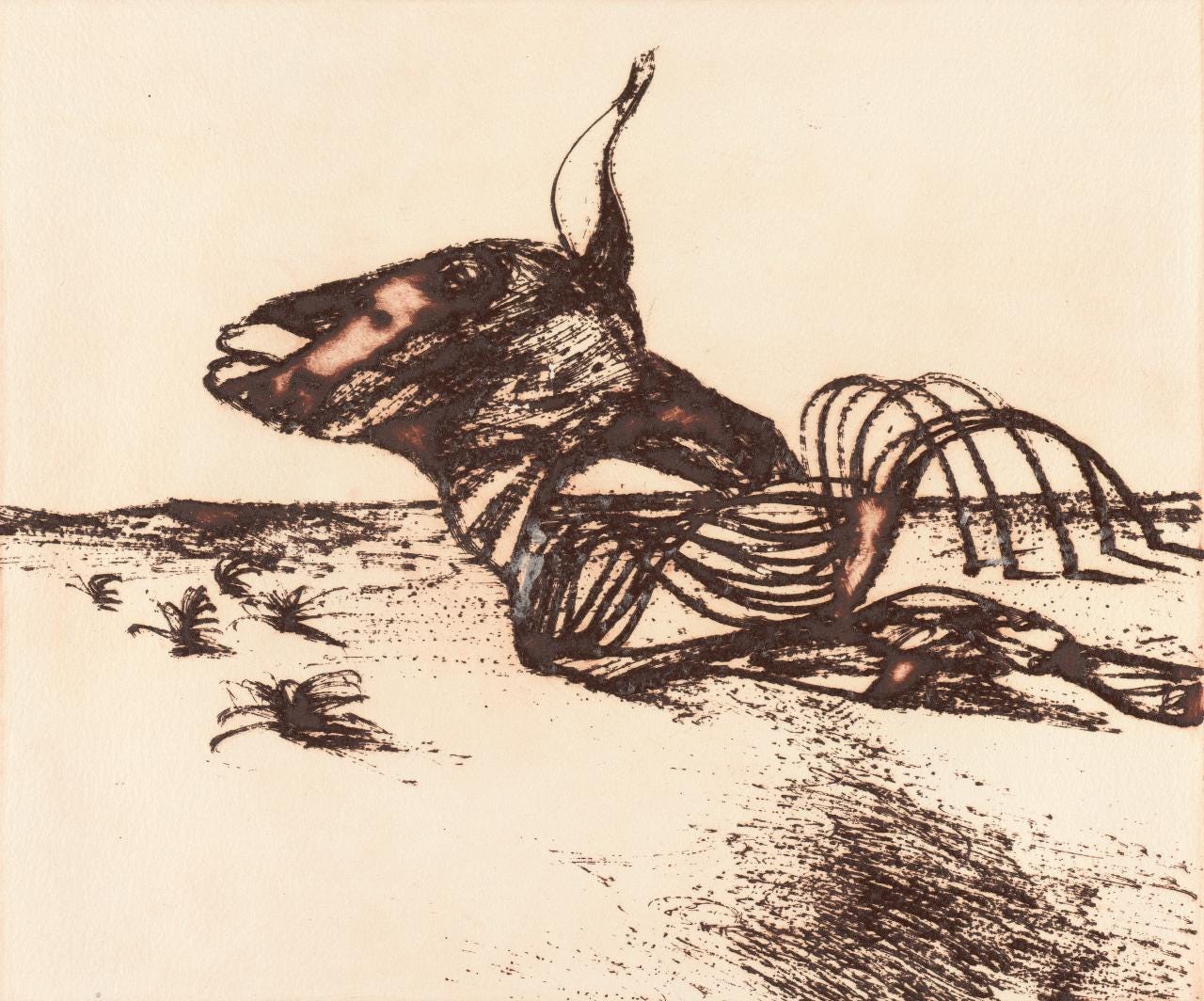
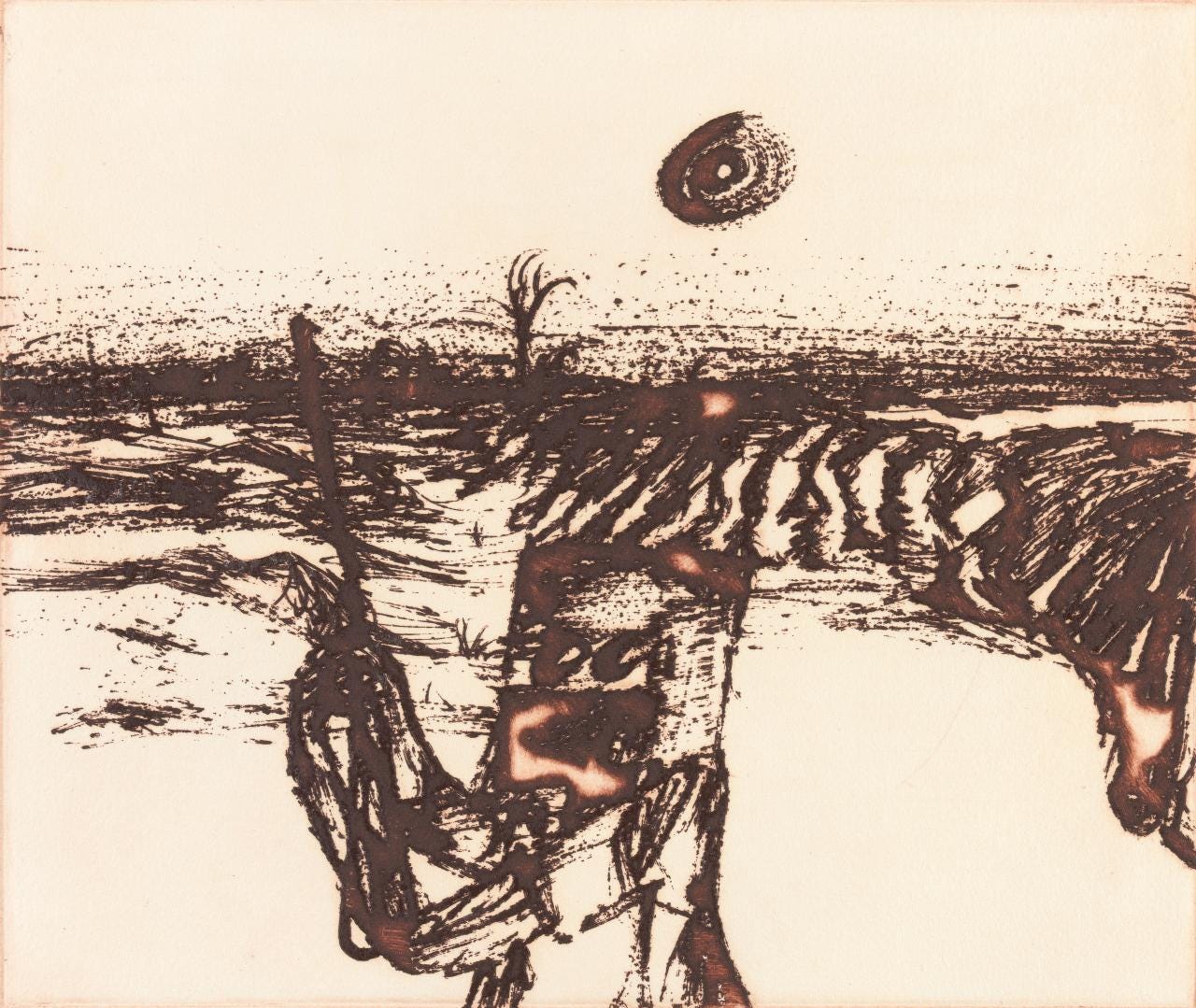
Illustrations
Sidney Nolan, Australia:
From the Dust suite: Carcase (1971), Kelly (1971)
Feedback and copyright
Author: Michael G. Heller in Social Science Files. This publication is recorded for referencing and copyright under the ORCID publications ID https://orcid.org/0009-0006-0935-0826
Do please send me your always extremely valuable comments by replying to this email or to HellerFiles@gmail.com
Assorted footnotes
Davis, R., Hatch, M., Hoare, S. et al. Earliest evidence of making fire. Nature (2025). https://doi.org/10.1038/s41586-025-09855-6
Tom Higham, The World Before Us: How Science is Revealing a New Story of Our Human Origins, Penguin Random House 2021; Robin Dunbar, Human Evolution, Penguin 2014
Ian Morris: “it’s a real challenge for evolutionary theory to say why we, once in a blue moon, get these bizarre cases of people who are basically hunter-gatherers producing stuff they should not be producing … they should not be living lives like this.” https://80000hours.org/podcast/episodes/ian-morris-deep-history-intelligence-explosion
See for examples: A. Nigel Goring-Morris and Anna Belfer-Cohen (editors), More Than Meets The Eye: Studies on Upper Palaeolithic Diversity in the Near East, Oxbow 2017