
Theorising First Societies
The five 'roles' of individuality

The official behind the counter and the citizen before it are in a sense not unique personalities, but Personae, masks, they are playing parts, roles. … At the point where individual and society intersect stands Homo Sociologicus, man as the bearer of socially predetermined roles. To a sociologist the individual is his social roles, but these roles, for their part, are the vexatious fact of society. … Roles are in principle conceivable without reference to particular persons.
Ralf Dahrendorf, Homo Sociologicus, Routledge, 1973
One
Before describing the fictional but logically probable process of the formation of a ‘first’ society in the Zagros we must introduce the concept of ‘individuality’ into the prehistoric context of ‘sociation’. Sociation, it will be recalled, refers to the process of forming and maintaining a society. Society is defined by its mode of governance. Governance is defined by the primary mode of decision making. Over the whole duration of prehistory and recorded history there have been a total of eight types of society, each with its corresponding special form of governance and decision making.
In the first society, pure biological individuality was the medium for sociation, for governance, and for decisions. In the absence as yet of governing ‘structures’ the pure individuality and volitional potential of each person’s contribution to the process of governing identified the original society and set it apart from all other existing groups.
While all groups and societies obviously contain individuals, the first society is simple enough to be reduced conceptually to just five individualistic biological functions: sex, age, personality, intelligence, and physique. Every individual sustains the burden or reaps the benefit of this preassigned combination of biological role capabilities. Invariant human biology of male-female sex differentiation cuts across the other categories. But in every non-sexual dimension an individual’s biological profile combines the strengths and weaknesses that correspond to their age, personality, intelligence, and physique.
All of these ‘natural’ endowments can improve or deteriorate over time in proportion to the individual’s motivation and volition, and correspond also with their particular individualised experiences of life. One can safely assume that a person’s intelligence, physique, personality and longevity could be 50 per cent genetically inherited and 50 per cent a result of their experience and exercise and application of each endowment.
At any given point in time these unique and complex biological profiles effectively categorise and determine that individual’s potential role in the process of governance. The important point to emphasise is that the ‘artificiality’ of governance as a decision making process exploits such uniquely individualised combinations of ‘natural’ traits.
We should therefore regard all of these prehistoric individuals as the bearers of socially predetermined political and economic roles. Homo Politikos and Homo Oikonomikos were equal in stature with Homo Sociologicus. The first society was highly ‘individualised’ because there was no political alternative to the dichotomous biological ‘superiority’ of one person’s abilities over another in each and every sphere of governance. This is why we should call it a ‘person-over-person’ society. Whatever activity is referred to, one person had a natural advantage over another person.
Every individual is in some critical respects more or less able to utilise the unique potential associated their combined sex, age, intelligence, physique and personality profile for the purpose of casting a greater influence over each group-level decision.
Everyone in the small group knew this and recognised the outstanding persons as deserving of disproportionate influence in the determination of decisions according to the topic under discussion (e.g. subsistence, safety, shelter, or social order).
Some people had less contributions to make in every field because their capabilities combined at a significantly lower threshold in all biological dimensions. The optimal combination in the prehistoric context would have been obvious to everyone — a physically imposing and unusually intelligent individual with notable charisma and long and varied experience of life’s great challenges in adversity. Given this group’s evolutionary nearness-in-time to our primate forebears that person was likely to have resembled the conventional alpha male dominator. But, the big difference in the post-alpha society was that this male and this group self-consciously curbed all dominance.
Two
Biological and cognitive preconditions for the formation of the first individualistic societies were the same as in Chiefdoms and among Levellers, namely modern human anatomy, large brains, and rudimentary language. Where they differed was the mode of governance. For its governance the person-over-person society relied in complex and fluid ways on preexisting biological markers of decision making influence (i.e. sex, age, intelligence, physique, personality) to carry through imperative action routines of shelter, subsistence, safety and social order. Biological differentiation determined the assignations of roles, as in divisions of labour. The first society exploited its biological variance by allocating social roles to performances of political or economic functions on the basis of how much improvement could be squeezed from heritable advantages.
Intelligence, sex, age, physique, personality were valued or disparaged according to their utility for the provisioning, defence and governance of the group. Allocation of roles was by discussion. Discussion was pre-structured by the contrasts in biological profile. This means that in every activity some men and some women were recognised as better performers of any given function than others. They were valued more highly.
The function (reflective of a certain genetic quality) could be a source of prestige, influence and leadership. This is why we refer to it as a ‘person-over-person’ society. At all points in their age- and sex-related life cycles the ‘gifted’ individuals exercised influence over others in accordance with natural comparative advantages. Biological differences between people became relevant to sociational actions of influence when they had been maximised for utility by the individual and then exploited by the group.
The crucial process to focus on is ‘governance’. Had we been contemporary observers we could have identified the first society by the fact that it gave more or less free rein to individual biological differentiations in the context of decision making. Within the group we would have observed the display of artificially staged contests created for the explicit purpose of revealing and profiting from the articulation of natural human inequalities across wide-ranging fields of necessary subsistence, safety, shelter and, increasingly over time, social order. When decision making ran up against obstacles they must have discussed alternative decision making processes in order to optimise according to the size and composition of the group. Evolutionary selection remained dynamic because the criteria for selection varied according to the type of decision.
In some tasks some men and women excelled. Even among a relatively small number of individuals the criss-crossing nature of biological differentiations relating to age, sex, intelligence, personality and physique ensured a constantly complex diversity in their comparative advantages for effective but highly situationally-specific decisions.
Three
Each of the eight societies is defined by its ‘over’ prioritisation — Person over Person; Group over Person; Persons over Group; Centre over Society; Group over Society; Rank over Centre; State over Society; System over System. The ‘over’ refers to the mode of governance. Usually the meaning of ‘over’ is self-evident. The second society is defined as ‘group over person’. This means the group has become more important than the person, and the group as a whole constrained the person. In the first society the ‘over’ preposition is less self-explanatory. It does not mean that one person governs over another person. It refers only to the fact that in each decision single persons were recognised as relatively more ‘qualified’ than others to influence the outcome of the decision. The demonstration of this superiority might be protracted, divisive and even theatrical. But the reason for the difference lay in individualised biological profiles.
From the perspective of overall governance — and because of people’s contrasting capabilities — each individual proposes, receives and approves or disapproves ideas in equal measure. In some proposals the person wins. In others the same person loses. In some proposals the individual is highly vocal. In others the individual remains silent.
The differentiation is seen in simultaneous roles assumed by the same person, who is an expert (or interested party) in some fields and a non-expert (or disinterested party) in other fields. In the context of the simple ‘ideal type’ societies with only biologically differentiated individuals, a single person assumes multiple participative governance personae simultaneously ‘over’ and ‘under’ other persons. This is the inner complexity of primitive society in its breakthrough to governance prior to governance ‘structure’.
In the dawn of history society had not yet developed a centre. It had not even acquired a real sense of itself as a group. When it reached a certain size it was clear to everyone that the group had become more important than its individuals. That recognition led to the evolution of explicitly ‘communalistic’ governance methods, which marked the transition from a ‘person over person’ society to a ‘group over person’ society. The first society could not yet have been aware of itself as a new sociational unit. It simply reacted against alternatives. It refused neoprimate domination. It refused networked levelling. It muddled through with amicable discussion and tolerated disagreement, argumentation and role differentiation without descending into disorder or brutality.
If the fledgling society did descend into breakdown, the process of transition was repeated over and over until a sustainable sociation solution was found. We may imagine ‘Type 1’ experimental sociation recurring regionally between 100,000 and 10,000 BCE.
Four
In evolutionary terms, the earliest and smallest decision-making unit was the couple. Negotiated coupling about divisions of labour and child care offered ideal training for group level discussions about politics, economy, welfare and the rules for social order.
What eventuated at the group level was procedurally similar to what we today refer to as a liberal-progressive nuclear ‘family’ or ‘coupling’ mode of decision making with a more or less balanced and uncontroversially utilitarian sharing of responsibilities. A convenient proxy-primitive for the ‘first’ and ‘second’ prehistoric societies could also be the small experimental communalistic living cooperatives and camper groups, which proliferated around Europe and North America during the 1960s and 1970s.
Nevertheless, the relevant chain of causation runs from society to family, not from family to society. It is important to recognise that only the formation of societies with group discussion about rules for governing multiple subgroups enabled the formalisation of families. Before and during the formation of first societies coupling-breeding units negotiated rules and divisions of labour according to particularistic self-regulating and naturalistic criteria in contexts of self-closure, privacy, mutual possession and micro-property. ‘Family’ structures developed considerably later in the contexts of authoritarian household administration, inheritance, contracts and formal regulation of status and property. The scope for the variation of arrangements in prehistory and proto-sociation was significant only as long as the group as a whole did not object to it. An early outcome may have been the ‘representation’ of couples within first societies.
In first societies an amicable and inclusive yet sharply competitive mode of discussing in-group collaborations, coordinations and action routines for survival will have been a direct result of their explicit rejections of the group dynamics of Domination and Levelling. Most first societies will have been populated by people with knowledge or experience of these two inferior primeval alternatives for cohabitation and labour.
For survival-with-prosperity the ‘person over person’ society experimented with roles for subsistence that protected and preserved the autonomy for individual initiatives in peaceable conditions of cohabitation and joint enterprise. It was a tricky combination which neither Dominance nor Levelling was capable of generating. A group society emerged where socially significant persons played two roles simultaneously as givers and receivers of ideas. This is what is meant by the orderly ‘individualistic society’ with a person-over-person governance mode. ‘Over’ refers to influence and expertise during debates that preceded governance ‘choices’ in matters of subsistence and social order.
The ability of one person to be ‘over’ another was not continuous. It was situational. The identity of the individuals who were the focal points of influence varied from case to case entirely according to the type of decision or the conveyance of particular types of hard knowledge. Individuals specialised in skills or knowledge, and were considered authoritative only if the topic under discussion fell within his or her area of expertise. The group was small and intimate. Audience and discussion participants had ample prior knowledge of each speaker’s distinctive interests, qualities and capabilities.
Five (repetitions in different words)
Person-over-Person is a classical Weberian ‘ideal type’ depiction of the first society. It accentuates a common feature of all ‘first’ societies, namely the variable or irregular basis of individuality in leadership and influence. It builds upon the five universally innate characteristics of differential human individuality — intelligence, personality, physique, age, and sex. With the exception of ‘sex’ these are differently combined in each individual depending on their natal genetic profiles and later life experience. The salient characteristics of quality and utility of leadership in whichever governance topic being discussed were a) biological grounding in one or more of the five individualities, and b) their growth through practise and age. ‘Leadership’ does not connote coercion.
A further feature of group governance under conditions of deliberately unfettered individuality is the competitiveness of the decision making process when expertise or skill was displayed by contrasting it with alternative interpretations or preferences.
Thus, competition served to reveal and announce the advantages and disadvantages endowed by birth to each individual according to intelligence, personality, physique, age or sex, and its improvement or decline in practical usage on behalf of impersonal group interests. From the group perspective there was no point in having such a gift if it was undisplayed. By the same token, if the biological endowment was a weakness rather than a strength then the function of competition was to reveal it for all to see.
Consistent with these observations we may say that the earliest form of sociational governance in the Individualistic Society sought simply to maximise virtues, strengths and utilities in each individual for the purpose of improving the quality of joint group endeavours. The prior Dominator group attributed all potency to an alpha male. The prior Leveller group repressed the expression and utility of individualistic potencies. The Sociational group recognised individuals with comparative potency advantages.
They sought to find, accentuate and exploit individual virtues. They recognised every person had a potential strength relative to some other person, and attempted to build on it. The phrase ‘person over person’ therefore refers to a potential advantage every person may have over another person in any particular activity or sphere of cognition.
Society builds on that potential. ‘Individualistic Society’ was super-conscious of the divisions of labour. It sought to cultivate collaboration and coordination on the basis of individual specialisation. The forum for organising was the whole-group meeting. It was public, so that all preferences and knowledge could be pooled and processed.
I previously indicated that every society is impersonal. However, every society ‘type’ is impersonal in a different way. We can identify differences between societies in terms of how impersonal governance is effectuated. As soon as we begin to speak of personal or individual qualities in biological varieties of sociopolitical and economic roles we are reminded that although the interactions are highly personalised in face-to-face terms (given the smallness of the group) they make their decisions impersonally, i.e. as a whole group, without relying on a single special person, and without need for preliminary coalitionists and cliquey formations. The determinants of the open and competitive process in first societies were in literal terms ‘organically’ impersonal. They were categorised by differentiations of age, sex, intelligence, physique and personality.
By Michael G. Heller
My Theory & History of Society began chronologically on Substack in Sept 2025 with The Politics of Becoming Human. Research began in 2020. Extensive filings of all bibliographic academic material, draft proposals and new theoretical concepts are archived from 2022.
Feedback, enquiries, copyright
Reply to the email or HellerFiles@gmail.com. This publication is recorded for referencing and copyright under the ORCID publications ID https://orcid.org/0009-0006-0935-0826
Illustration
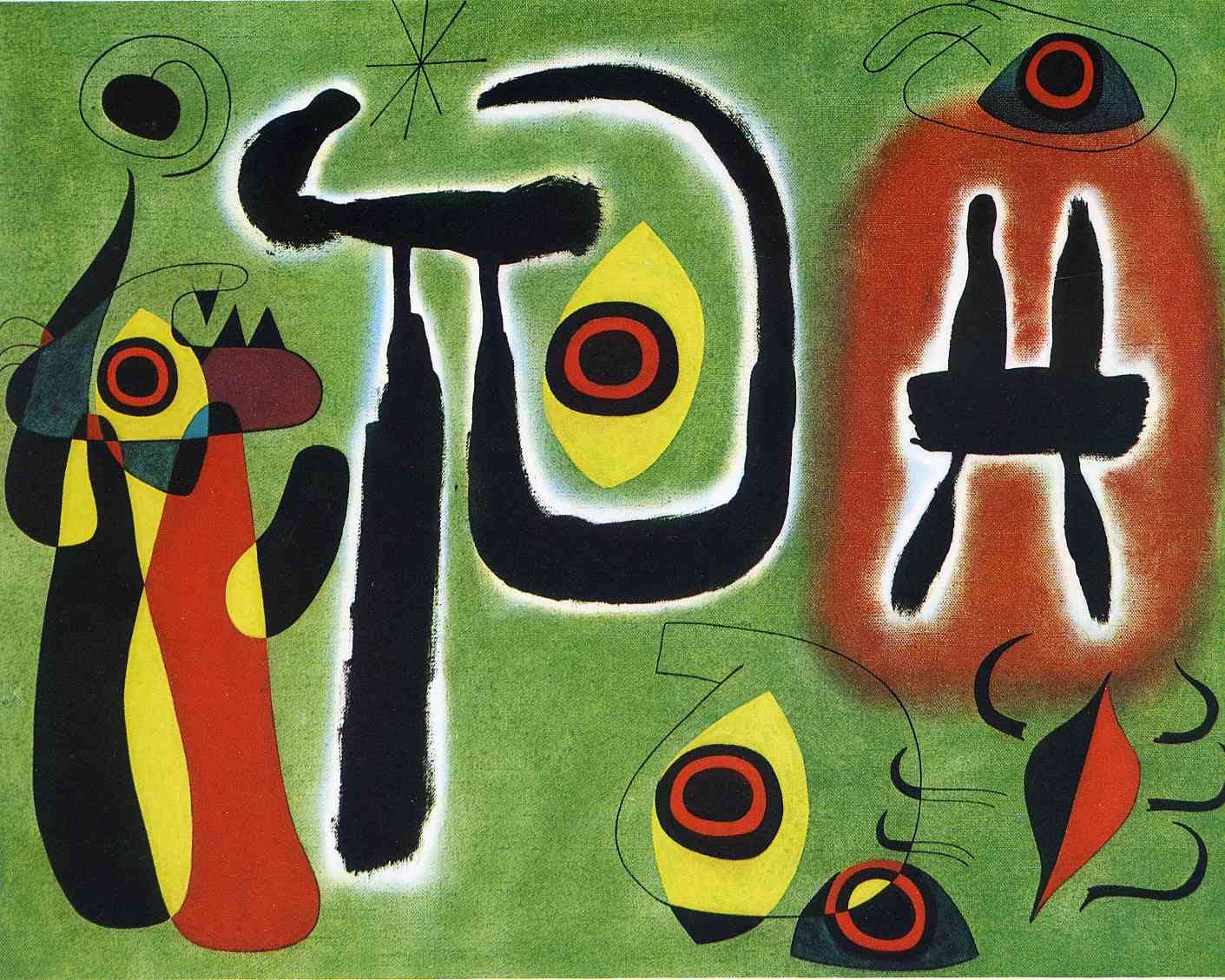
The Red Sun Gnaws at the Spider by Joan Miro 1948
[I chose this painting because I see 5 biomorphic eyes symbolising 5 human ‘roles’.]